Divine Board Game
An ancient 72-field spiritual board game rooted in the Vedic tradition. Each of the 72 sacred fields holds a unique teaching ab. Embeddable domain-locked widget, mobile-responsive.
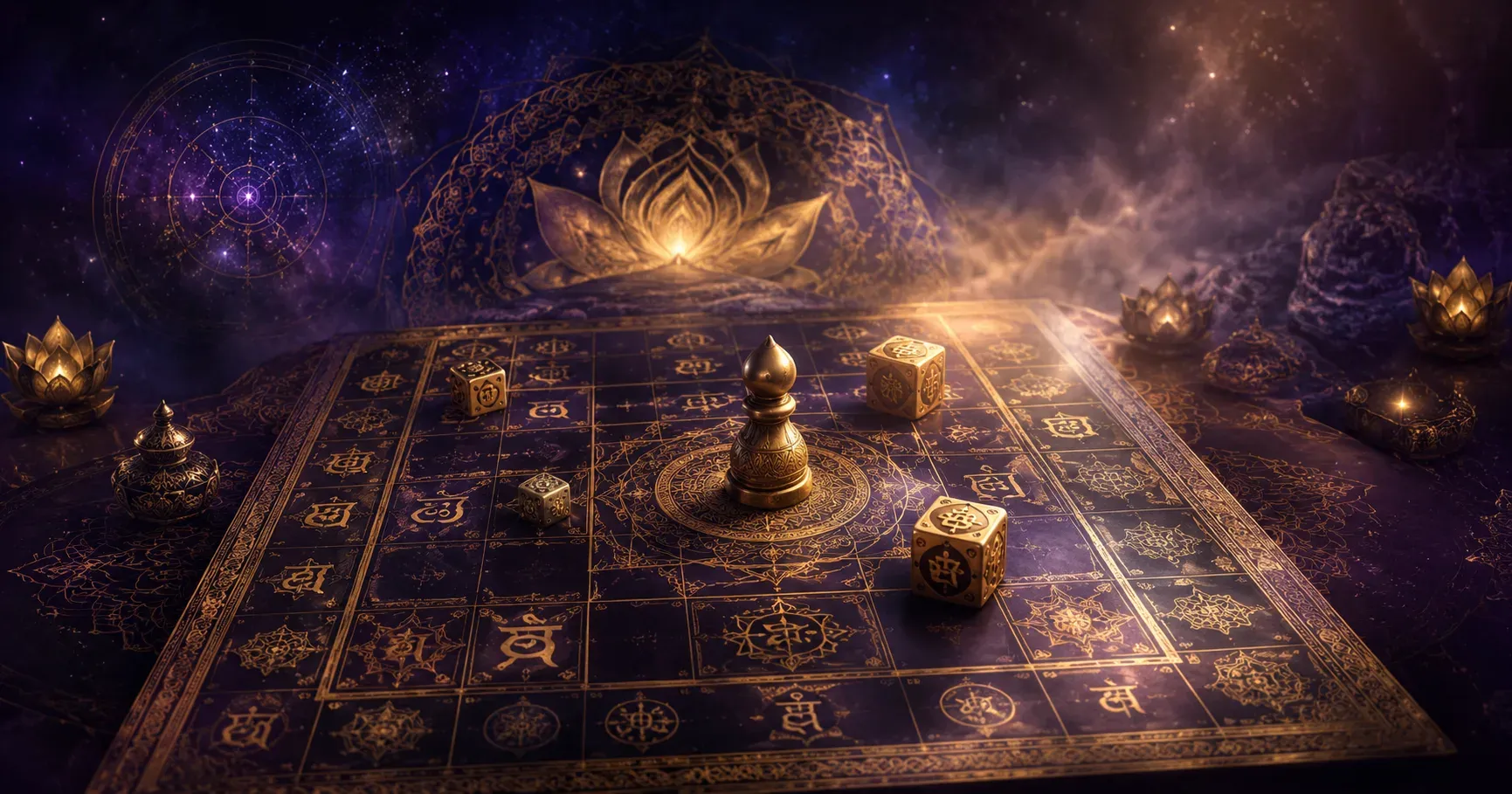
Lila - also known as Leela, or the Game of Knowledge - is an ancient Indian teaching tool that predates Snakes and Ladders (which it inspired). You roll, you land, you're told where you actually are on the board of your inner life. The 72 squares map stations of consciousness: pride, delusion, ignorance, discrimination, clarity, devotion, cosmic consciousness. The game doesn't let you skip squares. The snake you land on will take you somewhere you weren't planning to go. That's the point.
How it works
Bring a genuine question about your inner state or current life situation. Roll the dice - the oracle simulates the traditional roll and places you on the board. You see your square, its name, the teaching that belongs to it, and where the snake or ladder at that square sends you next (if present). The journey from where you land to the interpretation is the reading.
Understanding your result
Each of the 72 squares describes a real inner station. Square 10 (Purification): something is being cleaned - not pleasantly, but necessarily. Square 27 (Pride): you're up, and a snake is close. Square 54 (Discrimination): you can now tell real from false, and the game is asking you to use that. Square 68 (Cosmic Consciousness): a breakthrough in perception - rare to land here. In Lila tradition, where you land isn't arbitrary. It's where you are.
Frequently asked questions
Is this related to Snakes and Ladders?
Yes - Snakes and Ladders was derived from Lila when Indian games reached Victorian England. The moral framework was simplified and the teaching stripped out. Lila is the original teaching version, explicitly about consciousness and inner development.
Do I have to have a spiritual framework to use this?
No. The squares describe psychological and life situations that are recognizable regardless of your metaphysical views. Pride, delusion, clarity, and purification are human experiences, not sectarian concepts.
What if I land on a square that seems very negative?
In Lila, difficult squares are where the real teaching lives. Landing on a 'low' square isn't a punishment - it's a description of where you are right now, which is the only place growth can start from.
Is this for entertainment or self-development?
Specifically designed for self-development through play - it's a reflective game, not a passive reading. The best way to use it is with a real question and a willingness to sit with where you land.