Sacred Cross Spread
A five-card cross that balances opposing forces - what supports you, what challenges you, what lies beneath, and what crowns yo. Embeddable domain-locked widget, mobile-responsive.
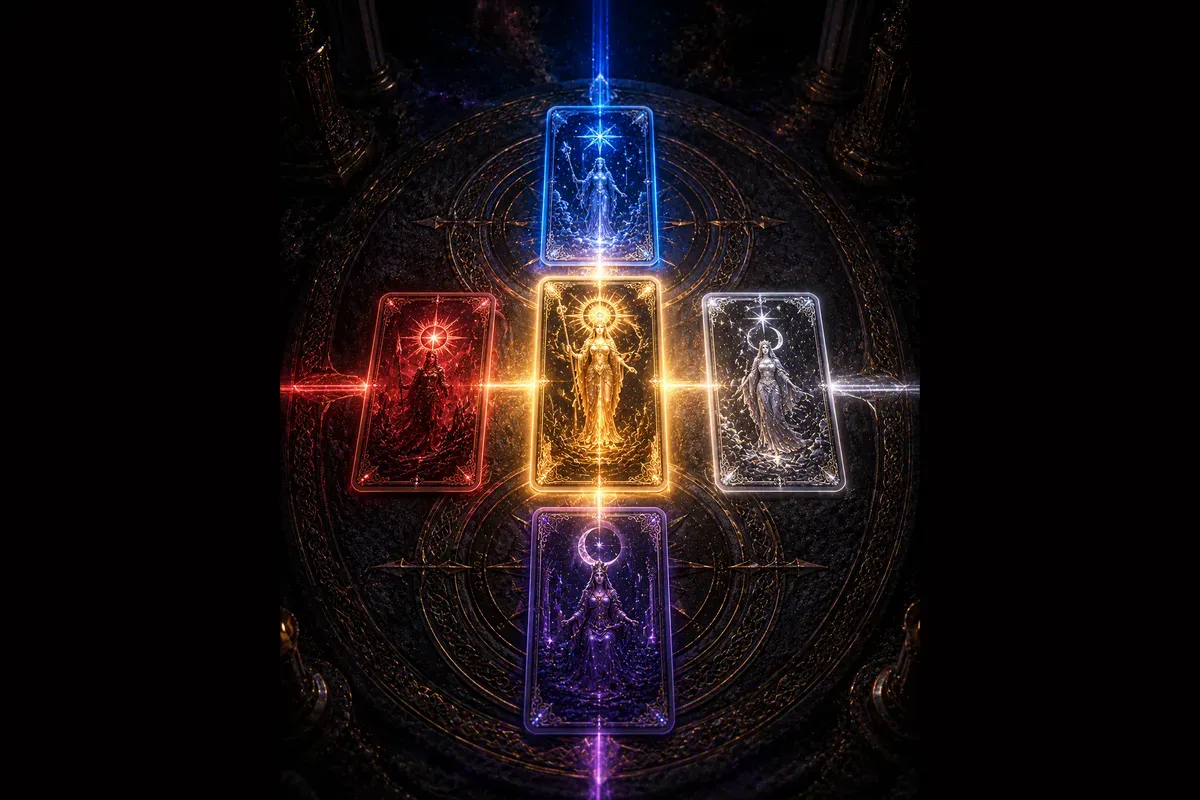
The Celtic Cross is the most used tarot spread in the world for a reason: it covers both the immediate situation and the broader field around it. Ten cards, six positions in the cross pattern, four in a vertical staff. It was codified in Arthur Edward Waite's 1910 guide to the Rider-Waite deck and hasn't needed updating since. If you want the full picture - the past, the near future, your own unconscious position, external influences, hopes, fears, and likely outcome - this is the spread for it.
How it works
State your question clearly - this spread works best with something specific rather than 'what is happening in my life generally.' Ten cards are dealt in the traditional cross-and-staff pattern. Each position is read individually and then in context with the whole. The reading takes longer than smaller spreads because the ten cards speak to each other across the layout.
Understanding your result
The cross section (six cards) addresses the core question: what's happening, what crosses it, the root, what's passing, what could manifest soon, and the direction of the immediate future. The staff (four cards) addresses context: your own position in the situation, external influences, your hopes and fears (often collapsed onto a single card and worth examining), and the final outcome. The interplay between the crossing card and the outcome card is often the most telling.
Frequently asked questions
Is the Celtic Cross actually Celtic?
The name comes from the cross-shaped layout, not from Celtic origins. It was popularized by the Hermetic Order of the Golden Dawn in the early 20th century and codified by Waite. The cultural label is historical misnomer, but the spread itself is well-established.
What does the 'hopes and fears' position actually mean?
It's one of the most interesting positions in the spread - sometimes it names what you're hoping for, sometimes what you fear, sometimes both in the same card. The distinction between hoping and fearing can be smaller than it looks. Sit with what arises.
Do I need tarot experience to understand a ten-card reading?
Not for this widget - each position comes with its interpretation written for plain reading. Tarot experience helps you go deeper, but it's not required to get something meaningful from the result.
How is this different from a smaller spread?
Smaller spreads (three-card, five-card) focus on a narrow question. The Celtic Cross covers the full terrain - what you don't know, external factors, timing, your psychological position. It's more information and requires more to read.